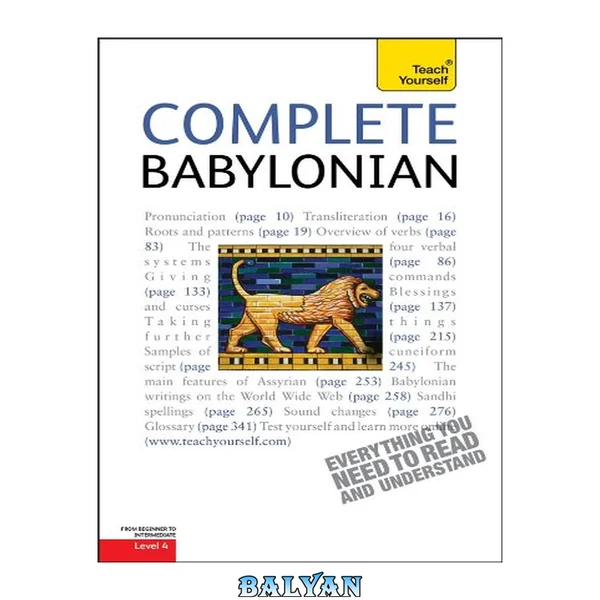
**Is this the right book for me?****Do you want to engage with Babylonian culture and literature in the original language?**The course will introduce you to a fascinating world of gods and demons, heroes and kings. The readings are drawn from myths, letters, law-codes, medical incantations, and other authentic, ancient writings. The language is presented in the Roman alphabet, with an explanation of cuneiform script, and the main features of Assyrian - cognate with Babylonian - are also explained. Learn effortlessly with a new easy-to-read page design and interactive features in this book from Teach Yourself, the No. 1 brand in language learning.**Complete Babylonian****includes:****Part one - Getting started**Chapter 1: IntroductionChapter 2: How to use this bookChapter 3: PronunciationChapter 4: Writing Babylonian in Roman CharactersChapter 5: Roots and patterns**Part two - Nouns and adjectives**Chapter 6: Overview of nouns and adjectivesChapter 7: Nouns and adjectives, singularChapter 8: Nouns, pluralChapter 9: Adjectives, pluralChapter 10: The construct stateChapter 11: Possessive suffixesChapter 12: The dualChapter 13: Prepositions**Part three - Strong verbs**Chapter 14: Overview of verbsChapter 15: The presentChapter 16: The preteriteChapter 17: The perfectChapter 18: The stative and the verbal adjectiveChapter 19: Verbs with accusative, dative and ventive suffixesChapter 20: The imperativeChapter 21: The precativeChapter 22: The infinitive**Part four: Weak and irregular verbs**Chapter 23: III-weak verbsChapter 24: I-weak verbsChapter 25: II-weak verbsChapter 26: I-__w__verbsChapter 27: Doubly weak verbsChapter 28: Three irregular verbs**Part five - Clauses into sentences**Chapter 29: Verbless clausesChapter 30: Joining clauses into sentencesChapter 31: Particularities of relative clauses with__s____a__Chapter 32: The interrelation of clauses**Part six - Further topics**Chapter 33: The Gtn, Dtn and Stn systemsChapter 34: The Gt, Dt and St systemsChapter 35: ParticiplesChapter 36: AdverbsChapter 37: Independent pronounsChapter 38: Quadrilateral verbsChapter 39: NumbersChapter 40: Cuneiform: some worked examplesChapter 41: The main features of AssyrianChapter 42: Taking things further**Part seven - Reference**Chapter 43: Some common wordsChapter 44: The main features of syllabic spellingsChapter 45: Summary of strong verbs' cores and suffixesChapter 46: Forming nouns and patternsChapter 47: Some sound changes**Learn effortlessly with a new easy-to-read page design and interactive features:****Not got much time?**One, five and ten-minute introductions to key principles to get you started.**Author insights**Lots of instant help with common problems and quick tips for success, based on the author's many years of experience.**Test yourself**Tests in the book and online to keep track of your progress.**Extend your knowledge**Extra online articles to give you a richer understanding of the subject.**Five things to remember**Quick refreshers to help you remember the key facts.**Try this**Innovative exercises illustrate what you've learnt and how to use it. Hodder Education Group Cover 1 Book title 2 Contents 6 Meet the author 16 Only got ten minutes? 17 Part one: Getting started 24 1 Introduction 24 1.1 Periods of the language 25 1.2 Reading fragments 26 1.3 Other books 27 2 How to use this book 28 2.1 The examples 28 2.2 The exercises 29 2.3 Units 44–47 31 2.4 Learning vocabulary 31 2.5 Learning grammar 31 3 Pronunciation 33 3.1 The sounds of Babylonian 33 3.2 Short and long vowels 35 3.3 Modern recordings 36 4 Writing Babylonian in Roman characters 37 4.1 Syllabic vs. sumerographic spellings 37 4.2 The element of choice in syllabic spellings 38 4.3 Transliteration 39 4.4 Normalization 40 5 Roots and patterns 42 Part two: Nouns and adjectives 44 6 Overview of nouns and adjectives 44 6.1 ‘A’, ‘the’, ‘some’, ‘any’ 44 6.2 Grammatical ‘case’ 45 6.3 The three cases 45 6.4 Vocatives 46 6.5 Grammatical ‘gender’ 46 6.6 Grammatical ‘number’ 47 6.7 Position of adjectives 48 6.8 Agreement between nouns and adjectives 48 6.9 Agreement between nouns in apposition 48 6.10 Words functioning as nouns 48 6.11 Mimation 49 6.12 Names and epithets 49 6.13 Babylonian singulars corresponding to English plurals 50 6.14 ‘-er’ and ‘-est’ 50 6.15 Emphatic -ma 51 6.16 ‘And’, ‘or’ 51 6.17 Compound words 51 7 Nouns and adjectives, singular 53 7.1 Old and Middle Babylonian 53 7.2 Standard Babylonian 55 7.3 Adjectives, masculine and feminine 56 8 Nouns, plural 60 8.1 Old and Middle Babylonian, masculine 60 8.2 Old and Middle Babylonian, feminine 60 8.3 Standard Babylonian 61 8.4 Changes caused by feminine plural endings 62 8.5 Vowel contraction in plurals 63 8.6 Nouns which occur in the plural only 64 8.7 Change of gender from singular to plural 64 8.8 Unusual plurals 64 9 Adjectives, plural 67 9.1 Old and Middle Babylonian, masculine 67 9.2 Old and Middle Babylonian, feminine 67 9.3 Standard Babylonian 68 9.4 Plurals of adjectives of dimension 68 9.5 Plurals of adjectives as nouns 69 9.6 Adjectival endings on plural nouns 69 10 The construct state 73 10.1 The origin of construct forms 73 10.2 Singular construct forms 74 10.3 Plural construct forms 77 10.4 Terminology and the idea of a noun’s ‘state’ 77 10.5 Chains of construct forms 78 10.6 Construct forms followed by multiple genitives 79 10.7 Adjectives qualifying nouns involved in genitive constructions 79 10.8 Translating genitive constructions 80 10.9 The archaic construct ending -u 80 11 Possessive suffixes 84 11.1 The suffixes 84 11.2 Learning the suffixes 85 11.3 Possessive suffixes and vowel elision 86 11.4 Possessive suffixes after plural nouns 86 11.5 Possessive suffixes after singular nouns in the genitive 87 11.6 Possessive suffixes after singular nouns in the nominative/accusative 87 11.7 Sound changes involving possessive suffixes 89 11.8 Unassimilated spellings 90 11.9 A special case: nouns from III-weak roots 90 11.10 Translating possessive suffixes 91 11.11 Suffixed nouns with adjectives 91 11.12 Possessive suffixes referring to ‘dangling words’ 92 11.13 Possessive suffixes anticipated by ša 93 11.14 Possessive suffixes attached to prepositions 93 12 The dual 98 12.1 Dual forms of nouns 98 12.2 Adjectives qualifying duals 99 12.3 Duals as subjects of verbs 99 13 Prepositions 101 13.1 Prepositions with and without suffixed pronouns 101 13.2 Prepositional phrases qualifying nouns 101 13.3 Short forms of ina and ana 102 13.4 Prepositions exclude each other 103 13.5 Prepositions introducing clauses 103 13.6 The suffix -a 104 13.7 Particularity of ša 104 Part three: Strong verbs 106 14 Overview of verbs 106 14.1 Position of the verb in the sentence 106 14.2 General principles of inflection 107 14.3 Agreement between subject and verb 107 14.4 Variables impinging on inflection 108 14.5 Verbs of being and verbs of doing 109 14.6 The four systems 109 14.7 The G system 110 14.8 The N system 110 14.9 The D system 110 14.10 The Š system 111 14.11 The derived systems 112 14.12 Strong and weak verbs 112 14.13 a-verbs and e-verbs 113 14.14 The dictionary form 113 14.15 Theme vowels 114 14.16 Impersonal masculine plurals 115 14.17 ‘To be able’ 115 14.18 Negation 115 15 The present 117 15.1 Uses of the present 117 15.2 Forms in the G, N, D and Š systems 117 15.3 Observations on the prefixes and suffixes 119 15.4 The vowel in the G and N systems 119 15.5 The present forms of parāsu in the G, N, D and Š systems 120 15.6 Sound changes 121 16 The preterite 124 16.1 Uses of the preterite 124 16.2 Forms in the G, N, D and Š systems 124 16.3 The vowel in the G and N systems 125 16.4 A sound change: vowel elision 126 16.5 A sound change: assimilation of n 126 17 The perfect 130 17.1 Uses of the perfect 130 17.2 Forms in the G, N, D and Š systems 131 17.3 The vowel in the G and N systems 132 17.4 Sound changes 132 18 The stative and the verbal adjective 135 18.1 The core forms for statives and verbal adjectives 135 18.2 The verbal adjective 136 18.3 The stative 137 18.4 Translating statives 137 18.5 Statives with an accusative 139 18.6 Forms of the stative in the G, N, D and Š systems 140 18.7 Observations on the stative suffixes 141 18.8 The stative of nouns 142 18.9 lū + stative 142 18.10 G statives of verbs of being from PRR roots 143 18.11 The intensifying Š system stative 143 18.12 Rarer forms of the stative endings 143 19 Verbs with accusative, dative and ventive suffixes 147 19.1 The accusative and dative suffixes 147 19.2 The first person singular dative suffix 148 19.3 Sound changes involving dative and accusative suffixes 149 19.4 Accusative replaces dative 150 19.5 The ventive suffix 150 19.6 The ventive suffix followed by dative and/or accusative suffixes 151 19.7 Loss of n in the ventive suffix -ni(m)- 152 19.8 Dative and accusative suffixes together 152 19.9 ‘Redundant’ suffixes 153 19.10 ‘Missing’ suffixes 153 20 The imperative 156 20.1 Positive and negative imperatives 156 20.2 Forms in the G, N, D and Š systems 156 20.3 The vowel in the G system 157 20.4 n as first root letter 158 21 The precative 160 21.1 Precatives of action: forms in the G, N, D and Š systems 160 21.2 Comments on positive forms 162 21.3 Comments on negative forms 162 21.4 Spellings of ay 163 21.5 Precatives of state 163 22 The infinitive 166 22.1 Forms in the G, N, D and Š systems 167 22.2 Infinitives with subjects and objects 167 22.3 ina + infinitive 169 22.4 ana + infinitive 169 22.5 Case attraction 170 22.6 The infinitive of emphasis 170 Part four: Weak and irregular verbs 173 23 III-weak verbs 173 23.1 The dictionary form 173 23.2 The theme vowel 174 23.3 General principles of inflection 174 23.4 Verbal ‘cores’ in the G, N, D and Š systems 175 23.5 The vowel in the G and N systems 175 23.6 e-verbs 176 24 I-weak verbs 179 24.1 The dictionary form 179 24.2 Forms in the G, N, D and Š systems 180 24.3 e-verbs 180 24.4 The vowel in the G system 181 24.5 The vowel in the N system 181 24.6 Why the long vowel? 182 24.7 Statives of verbs of being from PRR roots 182 24.8 I-weak verbs as strong verbs 182 25 II-weak verbs 186 25.1 The dictionary form 186 25.2 The theme vowel 186 25.3 Doubling of the third root letter instead of the second 187 25.4 Forms in the G, N, D and Š systems 188 25.5 The vowel in the G and N systems 189 25.6 Why â in the G and N present? 189 25.7 II-guttural verbs: weak and strong 190 25.8 The G infinitive of II-ī verbs in Old Babylonian 191 26 I-w verbs 195 26.1 I-w verbs of doing in Old Babylonian 195 26.2 Prefixes and suffixes 196 26.3 I-w verbs of being in Old Babylonian 197 26.4 Changes from Old Babylonian to later periods 197 27 Doubly weak verbs 201 27.1 Forms in the G, N, D and Š systems 201 27.2 Particularities of išû ‘to have’ and edû to ‘know’ 202 28 Three irregular verbs: alāku, izuzzu and itūlu 205 28.1 The forms of alāku 205 28.2 The forms of izuzzu 206 28.3 The forms of itūlu 207 Part five: Clauses into sentences 209 29 Verbless clauses 209 29.1 ‘To be’ in Babylonian 209 29.2 Situations where the stative cannot be used 210 29.3 Subject and predicate of verbless clauses 211 29.4 Examples of verbless clauses 211 29.5 Which tense in translation? 212 29.6 Negating verbless clauses 213 29.7 Verbless clauses with lū 213 29.8 Verbless clauses as questions 213 29.9 Verbs within verbless clauses! 213 30 Joining clauses into sentences 216 30.1 The particle -ma 216 30.2 The conjunction u 217 30.3 Subordinate clauses 217 30.4 šumma ‘if’ 218 30.5 Prepositions as subordinators 219 30.6 Nouns in the construct state as subordinators 220 30.7 The verbal suffix -u 221 30.8 The verbal suffix -u : where and when 222 30.9 Changes induced by the verbal suffix -u 223 30.10 Verbless clauses as subordinate clauses 223 30.11 Subordinate clauses within verbless clauses 224 31 Particularities of relative clauses with ša 229 31.1 How to say ‘whose’ 229 31.2 ša ‘the person who ...’, ‘the thing which ...’ 229 31.3 ša ‘which’ and prepositions 231 32 The interrelation of clauses 234 32.1 Precatives expressing purpose or result 234 32.2 -ma expressing purpose or result 235 32.3 -ma expressing ‘if’ 235 32.4 Hendiadys 236 Part six: Further topics 238 33 The Gtn, Ntn, Dtn and Štn systems 238 33.1 The meaning of the Gtn, Ntn, Dtn and Štn systems 239 33.2 Forms in the Gtn, Ntn, Dtn and Štn systems 239 33.3 Examples of -tan- forms 242 33.4 Assimilations 243 33.5 n as first root letter 244 33.6 t, d, z, s and s as first root letter 244 34 The Gt, Dt and Št systems 246 34.1 Forms in the Gt, Dt and Št systems 246 34.2 n as first root letter 248 34.3 t, d, z, s and s as first root letter 249 34.4 Assimilations 249 34.5 The meanings of the Gt system 249 34.6 The meanings of the Dt system 250 34.7 The two Št systems and their meanings 250 35 Participles 253 35.1 Forms of masculine participles for strong verbs 253 35.2 Forms of masculine participles for III-weak verbs 254 35.3 Forms of masculine participles for I-weak verbs 254 35.4 Forms of masculine participles for II-weak verbs 255 35.5 Plural endings 256 35.6 Unusual participles 256 36 Adverbs 257 36.1 Adverbial phrases 257 36.2 Adverbs in -iš and -āniš 258 36.3 Adverbs in -iš and -āniš followed by genitives and possessive suffixes 259 36.4 Adverbs in -išam 259 36.5 The accusative used as an adverb 259 36.6 Adverbs in -ī 260 36.7 Adverbs in -ī- followed by possessive suffixes 261 36.8 Adverbs in -atta(m), -atti 261 36.9 Adverbs in -um 261 36.10 Adverbs in -um followed by genitives and possessive suffixes 261 36.11 Adverbs after prepositions and nouns in the construct state 262 37 Independent pronouns 264 38 Quadriliteral verbs 266 39 Numbers 267 40 Cuneiform: some worked examples 268 41 The main features of Assyrian 276 41.1 Vowels 277 41.2 Consonants 277 41.3 Verbs 278 41.4 Nouns 279 41.5 Other 279 42 Taking things further 280 42.1 Dictionaries 280 42.2 Sign lists 281 42.3 Babylonian and Assyrian on the WWW 281 Part seven: Reference 283 43 Some common words 283 List of common words (and phrases) 284 44 The main features of syllabic spellings 287 44.1 Ambiguous spellings 287 44.2 Contracted vowels at the end of words 288 44.3 Sandhi spellings 288 44.4 Spellings of the glottal stop 288 44.5 Morpho-graphemic spellings 289 44.6 Morpho-phonological spellings 289 44.7 Purely orthographic consonantal doubling 289 44.8 Vowel-indifference 290 44.9 Plene spellings marking questions 290 44.10 The sign sequence a-a 290 44.11 Fossilized spellings 290 45 Summary of strong verbs’ cores and suffixes 291 45.1 Overview of cores for strong verbs 291 45.2 Overview of prefixes and suffixes 293 46 Forming nouns and adjectives 294 46.1 Patterns 294 46.2 ‘Nisbe’ adjectives 296 46.3 Gentilic adjectives 297 46.4 The importance of parent verbs 297 47 Some sound changes 299 47.1 Vowel contraction 299 47.2 Compensatory lengthening 300 47.3 Vowel elision across words (crasis) 300 47.4 Vowel elision within words 300 47.5 Division into syllables 301 47.6 The loss of short vowels at the end of words 302 47.7 The loss of guttural consonants 302 47.8 Long vowels inducing consonant doubling 302 47.9 Assimilation of consonants 303 47.10 Assimilations involving the verbal -t- infix 303 47.11 Nasalization of double consonants 304 47.12 The change of ma- to na- 304 47.13 Sound sequences which Babylonian does not allow 304 47.14 Two hypotheses 305 Sumerograms and their Babylonian equivalents 306 Key to the exercises 312 Glossary 364 A 364 B 366 D 367 E 368 G 369 H 370 I 371 K 372 L 373 M 374 N 377 P 379 Q 380 R 381 S 382 T 386 U 387 W 388 Z 388 Abbreviations 390 Index 394 9780340983881.,9781444127560. 9780340983881. 9781444127560. Is this the right book for me? Do you want to engage with Babylonian culture and literature in the original language? The course will introduce you to a fascinating world of gods and demons, heroes and kings. The readings are drawn from myths, letters, law-codes, medical incantations, and other authentic, ancient writings. The language is presented in the Roman alphabet, with an explanation of cuneiform script, and the main features of Assyrian - cognate with Babylonian - are also explained. Learn effortlessly with a new easy-to-read page design and interactive features in this book from Teach Yourself, the No. 1 brand in language learning. Complete Babylonian includes: Part one - Getting started Chapter 1: Introduction Chapter 2: How to use this book Chapter 3: Pronunciation Chapter 4: Writing Babylonian in Roman Characters Chapter 5: Roots and patterns Part two - Nouns and adjectives Chapter 6: Overview of nouns and adjectives Chapter 7: Nouns and adjectives, singular Chapter 8: Nouns, plural Chapter 9: Adjectives, plural Chapter 10: The construct state Chapter 11: Possessive suffixes Chapter 12: The dual Chapter 13: Prepositions Part three - Strong verbs Chapter 14: Overview of verbs Chapter 15: The present Chapter 16: The preterite Chapter 17: The perfect Chapter 18: The stative and the verbal adjective Chapter 19: Verbs with accusative, dative and ventive suffixes Chapter 20: The imperative Chapter 21: The precative Chapter 22: The infinitive Part four: Weak and irregular verbs Chapter 23: III-weak verbs Chapter 24: I-weak verbs Chapter 25: II-weak verbs Chapter 26: I- w verbs Chapter 27: Doubly weak verbs Chapter 28: Three irregular verbs Part five - Clauses into sentences Chapter 29: Verbless clauses Chapter 30: Joining clauses into sentences Chapter 31: Particularities of relative clauses with s a Chapter 32: The interrelation of clauses Part six - Further topics Chapter 33: The Gtn, Dtn and Stn systems Chapter 34: The Gt, Dt and St systems Chapter 35: Participles Chapter 36: Adverbs Chapter 37: Independent pronouns Chapter 38: Quadrilateral verbs Chapter 39: Numbers Chapter 40: Cuneiform: some worked examples Chapter 41: The main features of Assyrian Chapter 42: Taking things further Part seven - Reference Chapter 43: Some common words Chapter 44: The main features of syllabic spellings Chapter 45: Summary of strong verbs' cores and suffixes Chapter 46: Forming nouns and patterns Chapter 47: Some sound changes Learn effortlessly with a new easy-to-read page design and interactive features: Not got much time? One, five and ten-minute introductions to key principles to get you started. Author insights Lots of instant help with common problems and quick tips for success, based on the author's many years of experience. Test yourself Tests in the book and online to keep track of your progress. Extend your knowledge Extra online articles to give you a richer understanding of the subject. Five things to remember Quick refreshers to help you remember the key facts. Try this Innovative exercises illustrate what you've learnt and how to use it.