
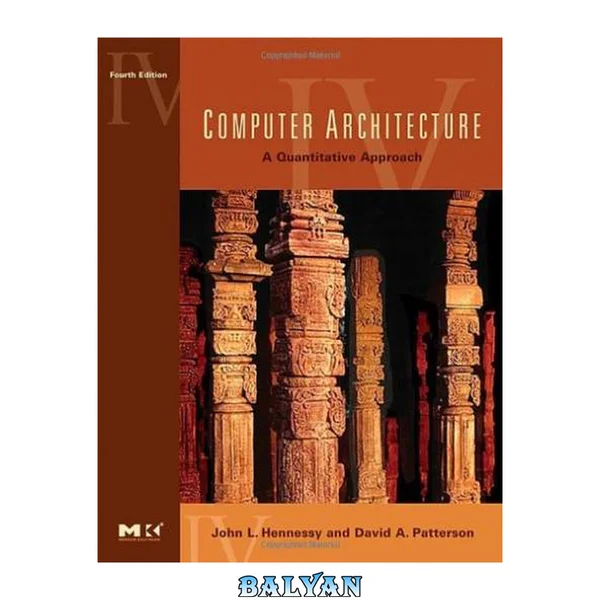
Computer Architecture: A Quantitative Approach, 4th Edition
John L. Hennessy, David A. Patterson; with contributions by Andrea C. Arpaci-Dusseau ... [et al.]قیمت نهایی
- تخفیف زماندار−۵٬۰۰۰ تومان
۵٬۰۰۰ تومان صرفهجویی نسبت به قیمت اصلی
نسخه اصلی و اورجینال
بلافاصله پس از خرید، فایل کتاب روی دستگاه شما آمادهٔ دانلود است.
مشخصات کتاب
- نویسنده
- John L. Hennessy, David A. Patterson; with contributions by Andrea C. Arpaci-Dusseau ... [et al.]
- سال انتشار
- ۲۰۰۶
- فرمت
- زبان
- انگلیسی
- حجم فایل
- ۲۹۸٫۸ مگابایت
- شابک
- 9780080475028، 9780123704900، 9780123735904، 0080475027، 0123704901، 0123735904
دربارهٔ کتاب
Chapter One Fundamentals of Computer Design
And now for something completely different. Monty Python's Flying Circus
1.1 Introduction
Computer technology has made incredible progress in the roughly 60 years since the first general-purpose electronic computer was created. Today, less than $500 will purchase a personal computer that has more performance, more main memory, and more disk storage than a computer bought in 1985 for 1 million dollars. This rapid improvement has come both from advances in the technology used to build computers and from innovation in computer design.
Although technological improvements have been fairly steady, progress arising from better computer architectures has been much less consistent. During the first 25 years of electronic computers, both forces made a major contribution, delivering performance improvement of about 25% per year. The late 1970s saw the emergence of the microprocessor. The ability of the microprocessor to ride the improvements in integrated circuit technology led to a higher rate of improvement—roughly 35% growth per year in performance.
This growth rate, combined with the cost advantages of a mass-produced microprocessor, led to an increasing fraction of the computer business being based on microprocessors. In addition, two significant changes in the computer marketplace made it easier than ever before to be commercially successful with a new architecture. First, the virtual elimination of assembly language programming reduced the need for object-code compatibility. Second, the creation of standardized, vendor-independent operating systems, such as UNIX and its clone, Linux, lowered the cost and risk of bringing out a new architecture.
These changes made it possible to develop successfully a new set of architectures with simpler instructions, called RISC (Reduced Instruction Set Computer) architectures, in the early 1980s. The RISC-based machines focused the attention of designers on two critical performance techniques, the exploitation of instruction-level parallelism (initially through pipelining and later through multiple instruction issue) and the use of caches (initially in simple forms and later using more sophisticated organizations and optimizations).
The RISC-based computers raised the performance bar, forcing prior architectures to keep up or disappear. The Digital Equipment Vax could not, and so it was replaced by a RISC architecture. Intel rose to the challenge, primarily by translating x86 (or IA-32) instructions into RISC-like instructions internally, allowing it to adopt many of the innovations first pioneered in the RISC designs. As transistor counts soared in the late 1990s, the hardware overhead of translating the more complex x86 architecture became negligible.
Figure 1.1 shows that the combination of architectural and organizational enhancements led to 16 years of sustained growth in performance at an annual rate of over 50%—a rate that is unprecedented in the computer industry.
The effect of this dramatic growth rate in the 20th century has been twofold. First, it has significantly enhanced the capability available to computer users. For many applications, the highest-performance microprocessors of today outperform the supercomputer of less than 10 years ago.
Second, this dramatic rate of improvement has led to the dominance of microprocessor-based computers across the entire range of the computer design. PCs and Workstations have emerged as major products in the computer industry. Minicomputers, which were traditionally made from off-the-shelf logic or from gate arrays, have been replaced by servers made using microprocessors. Mainframes have been almost replaced with multiprocessors consisting of small numbers of off-the-shelf microprocessors. Even high-end supercomputers are being built with collections of microprocessors.
These innovations led to a renaissance in computer design, which emphasized both architectural innovation and efficient use of technology improvements. This rate of growth has compounded so that by 2002, high-performance microprocessors are about seven times faster than what would have been obtained by relying solely on technology, including improved circuit design.
However, Figure 1.1 also shows that this 16-year renaissance is over. Since 2002, processor performance improvement has dropped to about 20% per year due to the triple hurdles of maximum power dissipation of air-cooled chips, little instruction-level parallelism left to exploit efficiently, and almost unchanged memory latency. Indeed, in 2004 Intel canceled its high-performance uniprocessor projects and joined IBM and Sun in declaring that the road to higher performance would be via multiple processors per chip rather than via faster uniprocessors. This signals a historic switch from relying solely on instruction-level parallelism (ILP), the primary focus of the first three editions of this book, to thread-level parallelism (TLP) and data-level parallelism (DLP), which are featured in this edition. Whereas the compiler and hardware conspire to exploit ILP implicitly without the programmer's attention, TLP and DLP are explicitly parallel, requiring the programmer to write parallel code to gain performance.
This text is about the architectural ideas and accompanying compiler improvements that made the incredible growth rate possible in the last century, the reasons for the dramatic change, and the challenges and initial promising approaches to architectural ideas and compilers for the 21st century. At the core is a quantitative approach to computer design and analysis that uses empirical observations of programs, experimentation, and simulation as its tools. It is this style and approach to computer design that is reflected in this text. This book was written not only to explain this design style, but also to stimulate you to contribute to this progress. We believe the approach will work for explicitly parallel computers of the future just as it worked for the implicitly parallel computers of the past.
1.2 Classes of Computers
In the 1960s, the dominant form of computing was on large mainframes—computers costing millions of dollars and stored in computer rooms with multiple operators overseeing their support. Typical applications included business data processing and large-scale scientific computing. The 1970s saw the birth of the minicomputer, a smaller-sized computer initially focused on applications in scientific laboratories, but rapidly branching out with the popularity of timesharing—multiple users sharing a computer interactively through independent terminals. That decade also saw the emergence of supercomputers, which were high-performance computers for scientific computing. Although few in number, they were important historically because they pioneered innovations that later trickled down to less expensive computer classes. The 1980s saw the rise of the desktop computer based on microprocessors, in the form of both personal computers and workstations. The individually owned desktop computer replaced time-sharing and led to the rise of servers—computers that provided larger-scale services such as reliable, long-term file storage and access, larger memory, and more computing power. The 1990s saw the emergence of the Internet and the World Wide Web, the first successful handheld computing devices (personal digital assistants or PDAs), and the emergence of high-performance digital consumer electronics, from video games to set-top boxes. The extraordinary popularity of cell phones has been obvious since 2000, with rapid improvements in functions and sales that far exceed those of the PC. These more recent applications use embedded computers, where computers are lodged in other devices and their presence is not immediately obvious.
These changes have set the stage for a dramatic change in how we view computing, computing applications, and the computer markets in this new century. Not since the creation of the personal computer more than 20 years ago have we seen such dramatic changes in the way computers appear and in how they are used. These changes in computer use have led to three different computing markets, each characterized by different applications, requirements, and computing technologies. Figure 1.2 summarizes these mainstream classes of computing environments and their important characteristics.
Desktop Computing
The first, and still the largest market in dollar terms, is desktop computing. Desktop computing spans from low-end systems that sell for under $500 to high-end, heavily configured workstations that may sell for $5000. Throughout this range in price and capability, the desktop market tends to be driven to optimize price-performance. This combination of performance (measured primarily in terms of compute performance and graphics performance) and price of a system is what matters most to customers in this market, and hence to computer designers. As a result, the newest, highest-performance microprocessors and cost-reduced microprocessors often appear first in desktop systems (see Section 1.6 for a discussion of the issues affecting the cost of computers).
Desktop computing also tends to be reasonably well characterized in terms of applications and benchmarking, though the increasing use of Web-centric, interactive applications poses new challenges in performance evaluation.
Servers
As the shift to desktop computing occurred, the role of servers grew to provide larger-scale and more reliable file and computing services. The World Wide Web accelerated this trend because of the tremendous growth in the demand and sophistication of Web-based services. Such servers have become the backbone of large-scale enterprise computing, replacing the traditional mainframe.
For servers, different characteristics are important. First, dependability is critical. (We discuss dependability in Section 1.7.) Consider the servers running Google, taking orders for Cisco, or running auctions on eBay. Failure of such server systems is far more catastrophic than failure of a single desktop, since these servers must operate seven days a week, 24 hours a day. Figure 1.3 estimates revenue costs of downtime as of 2000. To bring costs up-to-date, Amazon. com had $2.98 billion in sales in the fall quarter of 2005. As there were about 2200 hours in that quarter, the average revenue per hour was $1.35 million. During a peak hour for Christmas shopping, the potential loss would be many times higher.
Hence, the estimated costs of an unavailable system are high, yet Figure 1.3 and the Amazon numbers are purely lost revenue and do not account for lost employee productivity or the cost of unhappy customers.
A second key feature of server systems is scalability. Server systems often grow in response to an increasing demand for the services they support or an increase in functional requirements. Thus, the ability to scale up the computing capacity, the memory, the storage, and the I/O bandwidth of a server is crucial.
Lastly, servers are designed for efficient throughput. That is, the overall performance of the server—in terms of transactions per minute or Web pages served per second—is what is crucial. Responsiveness to an individual request remains important, but overall efficiency and cost-effectiveness, as determined by how many requests can be handled in a unit time, are the key metrics for most servers. We return to the issue of assessing performance for different types of computing environments in Section 1.8.
A related category is supercomputers. They are the most expensive computers, costing tens of millions of dollars, and they emphasize floating-point performance. Clusters of desktop computers, which are discussed in Appendix H, have largely overtaken this class of computer. As clusters grow in popularity, the number of conventional supercomputers is shrinking, as are the number of companies who make them.
Embedded Computers
Embedded computers are the fastest growing portion of the computer market. These devices range from everyday machines—most microwaves, most washing machines, most printers, most networking switches, and all cars contain simple embedded microprocessors—to handheld digital devices, such as cell phones and smart cards, to video games and digital set-top boxes.
(Continues...)
Excerpted from Computer Architecture by John L. Hennessy David A. Patterson Copyright © 2007 by Elsevier, Inc.. Excerpted by permission of MORGAN KAUFMANN. All rights reserved. No part of this excerpt may be reproduced or reprinted without permission in writing from the publisher.
Excerpts are provided by Dial-A-Book Inc. solely for the personal use of visitors to this web site. 000.jpg......Page 1 001.jpg......Page 2 002.jpg......Page 3 003.jpg......Page 4 004.jpg......Page 5 005.jpg......Page 6 006.jpg......Page 7 007.jpg......Page 8 008.jpg......Page 9 009.jpg......Page 10 010.jpg......Page 11 011.jpg......Page 12 012.jpg......Page 13 013.jpg......Page 14 014.jpg......Page 15 015.jpg......Page 16 016.jpg......Page 17 017.jpg......Page 18 018.jpg......Page 19 019.jpg......Page 20 020.jpg......Page 21 021.jpg......Page 22 022.jpg......Page 23 023.jpg......Page 24 024.jpg......Page 25 025.jpg......Page 26 026.jpg......Page 27 027.jpg......Page 28 028.jpg......Page 29 029.jpg......Page 30 030.jpg......Page 31 031.jpg......Page 32 032.jpg......Page 33 033.jpg......Page 34 034.jpg......Page 35 035.jpg......Page 36 036.jpg......Page 37 037.jpg......Page 38 038.jpg......Page 39 039.jpg......Page 40 040.jpg......Page 41 041.jpg......Page 42 042.jpg......Page 43 043.jpg......Page 44 044.jpg......Page 45 045.jpg......Page 46 046.jpg......Page 47 047.jpg......Page 48 048.jpg......Page 49 049.jpg......Page 50 050.jpg......Page 51 051.jpg......Page 52 052.jpg......Page 53 053.jpg......Page 54 054.jpg......Page 55 055.jpg......Page 56 056.jpg......Page 57 057.jpg......Page 58 058.jpg......Page 59 059.jpg......Page 60 060.jpg......Page 61 061.jpg......Page 62 062.jpg......Page 63 063.jpg......Page 64 064.jpg......Page 65 065.jpg......Page 66 066.jpg......Page 67 067.jpg......Page 68 068.jpg......Page 69 069.jpg......Page 70 070.jpg......Page 71 071.jpg......Page 72 072.jpg......Page 73 073.jpg......Page 74 074.jpg......Page 75 075.jpg......Page 76 076.jpg......Page 77 077.jpg......Page 78 078.jpg......Page 79 079.jpg......Page 80 080.jpg......Page 81 081.jpg......Page 82 082.jpg......Page 83 083.jpg......Page 84 084.jpg......Page 85 085.jpg......Page 86 086.jpg......Page 87 087.jpg......Page 88 088.jpg......Page 89 089.jpg......Page 90 090.jpg......Page 91 091.jpg......Page 92 092.jpg......Page 93 093.jpg......Page 94 094.jpg......Page 95 095.jpg......Page 96 096.jpg......Page 97 097.jpg......Page 98 098.jpg......Page 99 099.jpg......Page 100 100.jpg......Page 101 101.jpg......Page 102 102.jpg......Page 103 103.jpg......Page 104 104.jpg......Page 105 105.jpg......Page 106 106.jpg......Page 107 107.jpg......Page 108 108.jpg......Page 109 109.jpg......Page 110 110.jpg......Page 111 111.jpg......Page 112 112.jpg......Page 113 113.jpg......Page 114 114.jpg......Page 115 115.jpg......Page 116 116.jpg......Page 117 117.jpg......Page 118 118.jpg......Page 119 119.jpg......Page 120 120.jpg......Page 121 121.jpg......Page 122 122.jpg......Page 123 123.jpg......Page 124 124.jpg......Page 125 125.jpg......Page 126 126.jpg......Page 127 127.jpg......Page 128 128.jpg......Page 129 129.jpg......Page 130 130.jpg......Page 131 131.jpg......Page 132 132.jpg......Page 133 133.jpg......Page 134 134.jpg......Page 135 135.jpg......Page 136 136.jpg......Page 137 137.jpg......Page 138 138.jpg......Page 139 139.jpg......Page 140 140.jpg......Page 141 141.jpg......Page 142 142.jpg......Page 143 143.jpg......Page 144 144.jpg......Page 145 145.jpg......Page 146 146.jpg......Page 147 147.jpg......Page 148 148.jpg......Page 149 149.jpg......Page 150 150.jpg......Page 151 151.jpg......Page 152 152.jpg......Page 153 153.jpg......Page 154 154.jpg......Page 155 155.jpg......Page 156 156.jpg......Page 157 157.jpg......Page 158 158.jpg......Page 159 159.jpg......Page 160 160.jpg......Page 161 161.jpg......Page 162 162.jpg......Page 163 163.jpg......Page 164 164.jpg......Page 165 165.jpg......Page 166 166.jpg......Page 167 167.jpg......Page 168 168.jpg......Page 169 169.jpg......Page 170 170.jpg......Page 171 171.jpg......Page 172 172.jpg......Page 173 173.jpg......Page 174 174.jpg......Page 175 175.jpg......Page 176 176.jpg......Page 177 177.jpg......Page 178 178.jpg......Page 179 179.jpg......Page 180 180.jpg......Page 181 181.jpg......Page 182 182.jpg......Page 183 183.jpg......Page 184 184.jpg......Page 185 185.jpg......Page 186 186.jpg......Page 187 187.jpg......Page 188 188.jpg......Page 189 189.jpg......Page 190 190.jpg......Page 191 191.jpg......Page 192 192.jpg......Page 193 193.jpg......Page 194 194.jpg......Page 195 195.jpg......Page 196 196.jpg......Page 197 197.jpg......Page 198 198.jpg......Page 199 199.jpg......Page 200 200.jpg......Page 201 201.jpg......Page 202 202.jpg......Page 203 203.jpg......Page 204 204.jpg......Page 205 205.jpg......Page 206 206.jpg......Page 207 207.jpg......Page 208 208.jpg......Page 209 209.jpg......Page 210 210.jpg......Page 211 211.jpg......Page 212 212.jpg......Page 213 213.jpg......Page 214 214.jpg......Page 215 215.jpg......Page 216 216.jpg......Page 217 217.jpg......Page 218 218.jpg......Page 219 219.jpg......Page 220 220.jpg......Page 221 221.jpg......Page 222 222.jpg......Page 223 223.jpg......Page 224 224.jpg......Page 225 225.jpg......Page 226 226.jpg......Page 227 227.jpg......Page 228 228.jpg......Page 229 229.jpg......Page 230 230.jpg......Page 231 231.jpg......Page 232 232.jpg......Page 233 233.jpg......Page 234 234.jpg......Page 235 235.jpg......Page 236 236.jpg......Page 237 237.jpg......Page 238 238.jpg......Page 239 239.jpg......Page 240 240.jpg......Page 241 241.jpg......Page 242 242.jpg......Page 243 243.jpg......Page 244 244.jpg......Page 245 245.jpg......Page 246 246.jpg......Page 247 247.jpg......Page 248 248.jpg......Page 249 249.jpg......Page 250 250.jpg......Page 251 251.jpg......Page 252 252.jpg......Page 253 253.jpg......Page 254 254.jpg......Page 255 255.jpg......Page 256 256.jpg......Page 257 257.jpg......Page 258 258.jpg......Page 259 259.jpg......Page 260 260.jpg......Page 261 261.jpg......Page 262 262.jpg......Page 263 263.jpg......Page 264 264.jpg......Page 265 265.jpg......Page 266 266.jpg......Page 267 267.jpg......Page 268 268.jpg......Page 269 269.jpg......Page 270 270.jpg......Page 271 271.jpg......Page 272 272.jpg......Page 273 273.jpg......Page 274 274.jpg......Page 275 275.jpg......Page 276 276.jpg......Page 277 277.jpg......Page 278 278.jpg......Page 279 279.jpg......Page 280 280.jpg......Page 281 281.jpg......Page 282 282.jpg......Page 283 283.jpg......Page 284 284.jpg......Page 285 285.jpg......Page 286 286.jpg......Page 287 287.jpg......Page 288 288.jpg......Page 289 289.jpg......Page 290 290.jpg......Page 291 291.jpg......Page 292 292.jpg......Page 293 293.jpg......Page 294 294.jpg......Page 295 295.jpg......Page 296 296.jpg......Page 297 297.jpg......Page 298 298.jpg......Page 299 299.jpg......Page 300 300.jpg......Page 301 301.jpg......Page 302 302.jpg......Page 303 303.jpg......Page 304 304.jpg......Page 305 305.jpg......Page 306 306.jpg......Page 307 307.jpg......Page 308 308.jpg......Page 309 309.jpg......Page 310 310.jpg......Page 311 311.jpg......Page 312 312.jpg......Page 313 313.jpg......Page 314 314.jpg......Page 315 315.jpg......Page 316 316.jpg......Page 317 317.jpg......Page 318 318.jpg......Page 319 319.jpg......Page 320 320.jpg......Page 321 321.jpg......Page 322 322.jpg......Page 323 323.jpg......Page 324 324.jpg......Page 325 325.jpg......Page 326 326.jpg......Page 327 327.jpg......Page 328 328.jpg......Page 329 329.jpg......Page 330 330.jpg......Page 331 331.jpg......Page 332 332.jpg......Page 333 333.jpg......Page 334 334.jpg......Page 335 335.jpg......Page 336 336.jpg......Page 337 337.jpg......Page 338 338.jpg......Page 339 339.jpg......Page 340 340.jpg......Page 341 341.jpg......Page 342 342.jpg......Page 343 343.jpg......Page 344 344.jpg......Page 345 345.jpg......Page 346 346.jpg......Page 347 347.jpg......Page 348 348.jpg......Page 349 349.jpg......Page 350 350.jpg......Page 351 351.jpg......Page 352 352.jpg......Page 353 353.jpg......Page 354 354.jpg......Page 355 355.jpg......Page 356 The era of seemingly unlimited growth in processor performance is over: single chip architectures can no longer overcome the performance limitations imposed by the power they consume and the heat they generate. Today, Intel and other semiconductor firms are abandoning the single fast processor model in favor of multi-core microprocessors--chips that combine two or more processors in a single package. In the fourth edition of Computer Architecture, the authors focus on this historic shift, increasing their coverage of multiprocessors and exploring the most effective ways of achieving parallelism as the key to unlocking the power of multiple processor architectures. Additionally, the new edition has expanded and updated coverage of design topics beyond processor performance, including power, reliability, availability, and dependability.
CD System Requirements
PDF Viewer
The CD material includes PDF documents that you can read with a PDF viewer such as Adobe, Acrobat or Adobe Reader. Recent versions of Adobe Reader for some platforms are included on the CD.
HTML Browser
The navigation framework on this CD is delivered in HTML and JavaScript. It is recommended that you install the latest version of your favorite HTML browser to view this CD. The content has been verified under Windows XP with the following browsers: Internet Explorer 6.0, Firefox 1.5; under Mac OS X (Panther) with the following browsers: Internet Explorer 5.2, Firefox 1.0.6, Safari 1.3; and under Mandriva Linux 2006 with the following browsers: Firefox 1.0.6, Konqueror 3.4.2, Mozilla 1.7.11.
The content is designed to be viewed in a browser window that is at least 720 pixels wide. You may find the content does not display well if your display is not set to at least 1024x768 pixel resolution.
Operating System
This CD can be used under any operating system that includes an HTML browser and a PDF viewer. This includes Windows, Mac OS, and most Linux and Unix systems.
Increased coverage on achieving parallelism with multiprocessors.
Case studies of latest technology from industry including the Sun Niagara Multiprocessor, AMD Opteron, and Pentium 4.
Three review appendices, included in the printed volume, review the basic and intermediate principles the main text relies upon.
Eight reference appendices, collected on the CD, cover a range of topics including specific architectures, embedded systems, application specific processors--some guest authored by subject experts. The era of seemingly unlimited growth in processor performance is over: single chip architectures can no longer overcome the performance limitations imposed by the power they consume and the heat they generate. Today, Intel and other semiconductor firms are abandoning the single fast processor model in favor of multi-core microprocessors--chips that combine two or more processors in a single package. In the fourth edition of __Computer Architecture__, the authors focus on this historic shift, increasing their coverage of multiprocessors and exploring the most effective ways of achieving parallelism as the key to unlocking the power of multiple processor architectures. Additionally, the new edition has expanded and updated coverage of design topics beyond processor performance, including power, reliability, availability, and dependability.**CD System Requirements**__PDF Viewer__The CD material includes PDF documents that you can read with a PDF viewer such as Adobe, Acrobat or Adobe Reader. Recent versions of Adobe Reader for some platforms are included on the CD.__HTML Browser__The navigation framework on this CD is delivered in HTML and JavaScript. It is recommended that you install the latest version of your favorite HTML browser to view this CD. The content has been verified under Windows XP with the following browsers: Internet Explorer 6.0, Firefox 1.5; under Mac OS X (Panther) with the following browsers: Internet Explorer 5.2, Firefox 1.0.6, Safari 1.3; and under Mandriva Linux 2006 with the following browsers: Firefox 1.0.6, Konqueror 3.4.2, Mozilla 1.7.11. The content is designed to be viewed in a browser window that is at least 720 pixels wide. You may find the content does not display well if your display is not set to at least 1024x768 pixel resolution.__Operating System__This CD can be used under any operating system that includes an HTML browser and a PDF viewer. This includes Windows, Mac OS, and most Linux and Unix systems. Increased coverage on achieving parallelism with multiprocessors.Case studies of latest technology from industry including the Sun Niagara Multiprocessor, AMD Opteron, and Pentium 4.Three review appendices, included in the printed volume, review the basic and intermediate principles the main text relies upon.Eight reference appendices, collected on the CD, cover a range of topics including specific architectures, embedded systems, application specific processors--some guest authored by subject experts.
کتابهای مشابه

Computer Architecture: A Quantitative Approach, 4th Edition
۴۹٬۰۰۰ تومان
Computer Architecture: A Quantitative Approach, 4th Edition
۴۹٬۰۰۰ تومان
Computer Architecture: A Quantitative Approach, 4th Edition
۴۹٬۰۰۰ تومان
Computer Architecture: A Quantitative Approach, 4th Edition, 2006
۴۹٬۰۰۰ تومان
Computer Architecture - A Quantitative Approach
۴۹٬۰۰۰ تومان
Computer Architecture : A Quantitative Approach
۴۹٬۰۰۰ تومان
Computer Architecture - A Quantitative Approach
۴۹٬۰۰۰ تومان
Computer Architecture : A Quantitative Approach
۴۹٬۰۰۰ تومان
Computer Architecture - A Quantitative Approach
۴۹٬۰۰۰ تومان
Computer architecture : a quantitative approach
۴۹٬۰۰۰ تومان
معماری کامپیوتر: رویکردی کمی
۴۹٬۰۰۰ تومان
Computer Architecture. A Quantitative Approach
۴۹٬۰۰۰ تومان
قیمت نهایی
۴۴٬۰۰۰ تومان