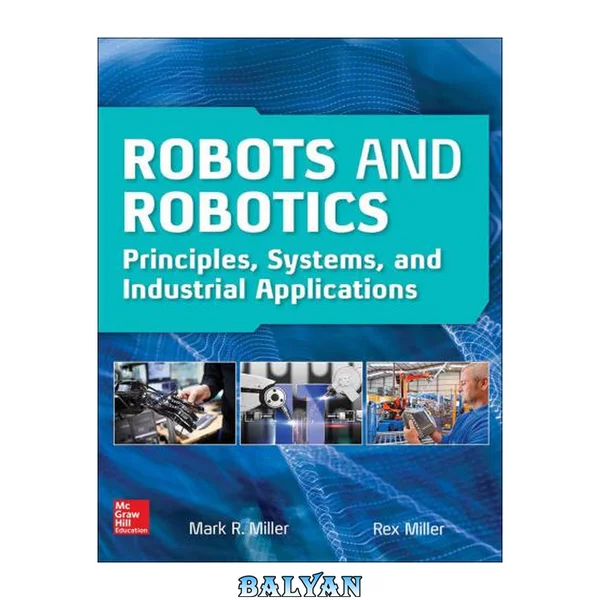
This book covers a wide range of topics relating to advanced industrial robotics, sensors and automation technologies. Although being highly technical and complex in nature, the papers presented in this book represent some of the latest cutting edge technologies and advancements in industrial robotics technology. This book covers topics such as networking, properties of manipulators, forward and inverse robot arm kinematics, motion path-planning, machine vision and many other practical topics too numerous to list here. The authors and editor of this book wish to inspire people, especially young ones, to get involved with robotic and mechatronic engineering technology and to develop new and exciting practical applications, perhaps using the ideas and concepts presented herein. The calibration system proposed showed to improve the robot accuracy to well below 1mm. The system allows a large variation in robot configurations, which is essential to proper calibration. A technique was used and a straightforward convention to build kinematic models for a manipulator was developed, ensuring that no singularities are present in the error model. Mathematical tools were implemented to optimize the kinematic model parameterization, avoiding redundancies between parameters and improving the parameter identification process. A portable, ease of use, speedy and reliable Vision-based measuring system using a single camera and a plane calibration board was developed and tested independently of the robot calibration process. The robot calibration system approach proposed here stood out to be a feasible alternative to the expensive and complex systems available today in the market, using a single camera and showing good accuracy and ease of use and setup. Results showed that the RAC model used (with slight modifications) is not very robust, since even for images filling the entire screen and captured at approximately the same distances from the target, the focus length was not constant and showed an average value shifted by approximately 3% from the exact one. This amount of error can produce 3-D measurement errors much larger than acceptable. Practically speaking, the solution for this problem developed here for a set of camera and lens was to use an external measurement system to calibrate the camera, at least once. The measurement accuracy obtained is comparable to the best found in academic literature for this type of system, with median values of accuracy of approximately 1:3,000 when compared to the distance from the target. However, this accuracy was obtained at considerable larger distances and different camera orientations than usual applications for cameras require, making the system suitable for robotic metrology. For future research it is suggested that the target plate and the calibration board have to be improved to permit the camera to be placed at larger ranges of distances from the target, allowing larger calibration volumes to be used. One path that might be followed is to construct a much larger calibration board, with localized clusters of calibration points of different sizes, instead of just one pattern of point distribution. So, if the camera is placed at a greater distance, larger dots can be used all over the area of the calibration board. If the camera is nearer to the target, smaller dots can be used at particular locations on the calibration board. Different dot sizes make easier for the vision processing software to recognize desired clusters of calibration points. Other sources of lens distortions such as decentering and thin prism can be also modeled, and so their influence on the final measurement accuracy can be understood. Another issue concerns the influence orientation measured data may have on the final accuracy. Non-geometric parameters such as link elasticity, gear elasticity and gear backlash might be modeled, and a larger number of parameters introduced in the model parameterization. This procedure may improve the accuracy substantially if the robot is used with greater payloads This chapter has reviewed fundamental concepts and technologies of the general interdisciplinary field described usually by a combination of the terms: Virtual, Augmented or Mixed Reality systems, with the emphasis being on their applications in robot teleoperation. We have first analysed the basics of VR and AR systems, which have shown a great progress of research and development activities during the last decade, demonstrating a constantly increasing repertoire of useful practical applications in diverse domains of human activity. We have then described application scenarios of such VR technologies in the general field of robotics, with the particular focus on telerobotic applications. We have started by presenting a brief historical survey of the field of telerobotics, and identified the major profits that are related to the integration of VR and AR techniques. Virtual environments can be seen as a means to achieve natural, intuitive, multimodal human/computer (and generally human/machine) interaction; in this sense, a VE can function as an efficient mediator between a human operator and a telerobot, with the main objectives being: (a) to enhance human perception of the remote task environment and therefore improve transparency of the telerobotic system, by enriching the visual information (complemented by other form of sensory and sensori-motor stimuli) provided to the user, thus conveying complex data in a more natural and easier way; (b) to contribute to the solution of the time-delay problem in bilateral teleoperation and improve stability of the telerobotic system, by extending the concept of predictive displays and offering a range of control metaphors for both operator assistance and robot autonomy sharing. We have presented a number of successful case studies, where VR techniques have been effectively applied in telerobotics, for the two main robotic systems categories, namely (i) robot manipulators and (ii) mobile robotic vehicles. A long-distance parallel telemanipulation experiment was described, where an intermediate virtual task representation was used involving direct hand actions by means of a VR glove device. The use of telerobotic technologies in a distance training (virtual and remote laboratory) application has been also demonstrated, with very promising results in this important domain. As related to the field of mobile service robotics, two application scenarios have been described, to highlight the benefits that can result from the integration of VR-based interfaces for the teleoperation of robotic vehicles for a variety of tasks, including service / intervention tasks and remote exploration. The link with the field of haptics is also Robust control software is a necessity for an automated FMS and FMC, and plays an important role in the attainable flexibility. Often FMS and FMC are built with very flexible machines (robots, CNC machines, ASRS, etc) but the available control software is unable to exploit the flexibility of adding new machines, parts, changing control algorithms, etc. The present robot control and CNC machines control systems are closed and with deficient software interfaces. Nowadays, the software is typically custom written, very expensive, difficult to modify, and often the main source of inflexibility in FMS. We have developed a collection of software tools: "winRS232ROBOTcontrol", "winEthernetROBOTcontrol", "winMILLcontrol", "winTURNcontrol" and USB software. These software tools allow the development of industrial applications of monitoring and controlling robotic networks and CNC machines inserted in FMS or FMC. All the software developed has operation potentialities in Ethernet. The basic idea is to define for any specific equipment a library of functions that in each moment define the basic functionality of that equipment for remote use. In this chapter we also propose a new concept of genetic operators for scheduling problems. We developed a software tool called HybFlexGA, to examine the performance of various crossover and mutation operators by computing simulations on job scheduling problems. The HybFlexGA obtained good computational results in the instances of SMTWT problems with 40, 50 and 100 jobs (see Table 6). As we demonstrated, the HybFlexGA is very efficient with the TPC4C+Arb20%JC combination. With this combination, the HybFlexGA always found more optimal solutions than with the other combinations: TPC3CV2+Arb20%JC, TPC2CV2+Arb20%JC, and so on. When we used this combination (TPC4C+Arb20%JC) in the HybFlexGA, the genetic algorithm required fewer generations and less CPU time to find the optimal solutions. These results show the good performance and efficiency of the HybFlexGA with the TPC4C and Arb20%JC genetic operators. Application of the HybFlexGA, with these same genetic operator combinations, in other scheduling problems (e.g. job-shop and flow-shop) is left for future work ICRA is a well-established conference in the field of robotics and automation, and covers a wide spectrum of science and technology, including not only application technologies for automation, but also the basic engineering principles of human-robotics science. The topic of ICRA'95 was "Robotics and Automation in Exploring New Engineering Disciplines." The proceedings include keynote lectures ("Systems Approach to Robotics and Automation" and "Impact of Multimedia Technology on Society and Industry"), a plenary lecture ("Adaptation and Learning in Robotics and Automation"), public lectures (abstracts), an industry forum (abstract), and 487 technical papers in 120 sessions. No subject index. Annotation copyright by Book News, Inc., Portland, OR The 14 papers presented at the June 1999 workshop are arranged into four sessions: detecting, tracking, and recognizing moving objects in infrared images; infrared image analysis and applications; target recognition in synthetic aperture radar (SAR) images; and laser radar and hyper-spectral image analysis. Among the topics are dual-band ATR for forward-looking infrared images, extending color vision methods to bands beyond the visible, adaptive target recognition, and a machine vision system using a laser radar applied to robotic fruit harvesting. No subject index. Annotation copyrighted by Book News, Inc., Portland, OR