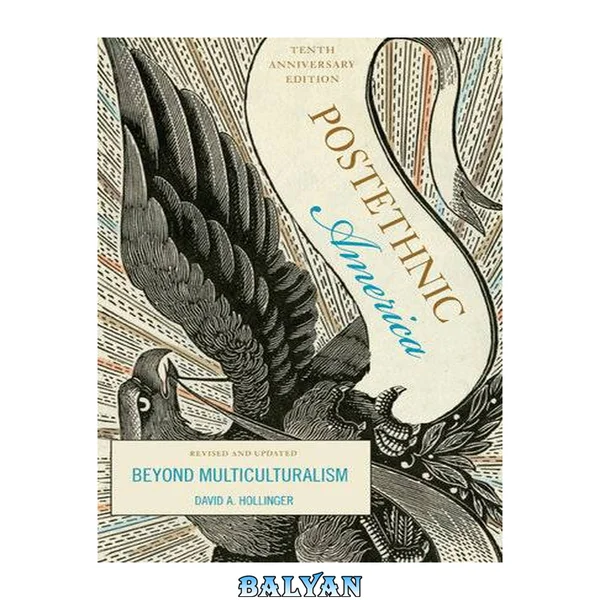
Sympathetic with the new ethnic consciousness, Hollinger argues that the conventional liberal toleration of all established ethnic groups no longer works because it leaves unchallenged the prevailing imbalance of power. Yet the multiculturalist alternative does nothing to stop the fragmenting of American society into competing ethnic enclaves, each concerned primarily with its own well-being. Hollinger argues instead for a new cosmopolitanism, an appreciation of multiple identities - new cross-cultural affiliations based not on the biologically given but on consent, on the right to emphasize or diminish the significance of one's ethnoracial affiliation. Postethnic America is a bracing reminder of America's universalist promise as a haven for all peoples. While recognizing the Eurocentric narrowness of that older universalism, Hollinger makes a stirring call for a new nationalism. He urges that a democratic nation-state like ours must help bridge the gap between our common fellowship as human beings and the great variety of ethnic and racial groups represented within the United States.This classic title was reprinted in 2000 with an added chapter from the author, "Postscript 2000," that updates Hollinger's book and makes its perspectives on multiculturalism even more relevant to contemporary society. Presents a bold proposal to heal the USA's ethnic divisions, by one of the country's foremost intellectual historians. Sympathetic with the ethnic consciousness, this book argues that the conventional liberal toleration of all established ethnic groups no longer works because it leaves unchallenged the prevailing imbalance of power. This is a reissue of David Hollinger's groundbreaking proposal for an enriched definition of American nationalism - with a new postscript in which the author reflects on the realities of race in America ten years on. "Postethnic America" is a bold proposal to heal the USA's ethnic divisions, by one of the country's foremost intellectual historians. Sympathetic with the new ethnic consciousness, Hollinger argues that the conventional liberal toleration of all established ethnic groups no longer works because it leaves unchallenged the prevailing imbalance of power. Yet, the multiculturalist alternative does nothing to stop the fragmenting of American society into competing ethnic enclaves, each concerned primarily with its own well-being. Hollinger argues instead for a new cosmopolitanism, an appreciation of multiple identities - new cross-cultural affiliations based not on the biologically given but on consent, on the right to emphasize or diminish the significance of one's ethno-racial affiliation. "Postethnic America" is a bracing reminder of America's universalist promise as a haven for all peoples. This classic title was reprinted in 2000 with an added chapter that updated the book and made it even more relevant to contemporary society. In this revised edition, he adds another postscript, to update the national conversation about race, ethnicity, identity politics and other issues. He also discusses major recent events including 9/11, which dramatically reshaped American nationalism, and Hurricane Katrina, which revealed the countries ugliest socioeconomic and racial divides "Sympathetic with the new ethnic consciousness, Hollinger argues that the conventional liberal toleration of all established ethnic groups no longer works because it leaves unchallenged the prevailing imbalance of power. Yet the multiculturalist alternative does nothing to stop the fragmenting of American society into competing ethnic enclaves, each concerned primarily with its own well-being." "Hollinger argues instead for a new cosmopolitanism, an appreciation of multiple identities - new cross-cultural affiliations based not on the biologically given but on consent, on the right to emphasize or diminish the significance of one's ethnoracial affiliation." "Postethnic America is a bracing reminder of America's universalist promise as a haven for all peoples. While recognizing the Eurocentric narrowness of that older universalism, Hollinger makes a stirring call for a new nationalism. He urges that a democratic nation-state like ours must help bridge the gap between our common fellowship as human beings and the great variety of ethnic and racial groups represented within the United States."--BOOK JACKET Multiculturalism is a prodigious movement, but its limitations are increasingly apparent. David A. Hollinger. Previous Ed.: 2002. Includes Bibliographical References And Index.

![آمریکای چندفرهنگی: دایرهالمعارف جدیدترین آمریکاییها [۴ جلد]](https://img.balyan.ir/book/180000/187615_md.webp)


