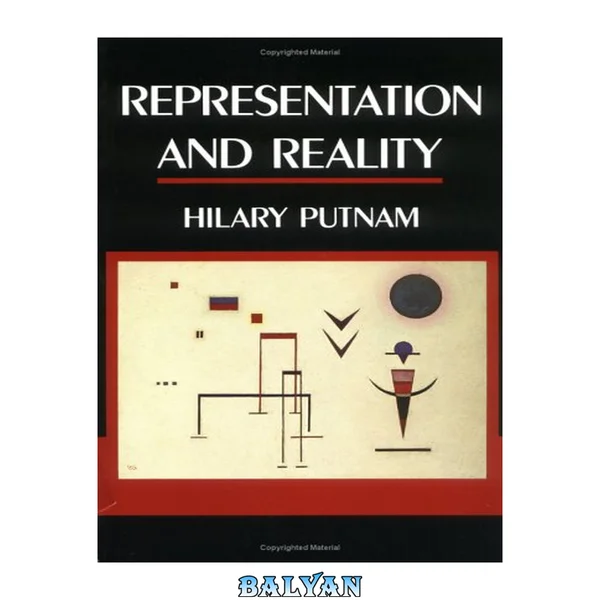
Hilary Putnam, who may have been the first philosopher to advance the notion that the computer is an apt model for the mind, takes a radically new view of his own theory of functionalism in this book. Putnam argues that in fact the computational or functionalist analogy cannot answer the important questions about the nature of such mental states as belief, reasoning, rationality, and knowledge that lie at the heart of the philosophy of mind. Putnam asserts that the "old" computational view that "our function is more important than our matter" needs new interpretation: mental states cannot be identified with physical-chemical states, or with functional states. He tackles the difficult question of whether there is a physical/computational "equivalence" between the structures of all possible systems containing a physically possible organism which holds a particular belief. If such an equivalence relation existed, Putnam notes, it would be undiscoverable. Not just undiscoverable by human beings, but undiscoverable by any possible physically intelligent beings. A Bradford Book. Preface Introduction Chapter 1 Meaning and Mentalism Fodor and Chomsky Three Reasons Why Mentalism Can't Be Right 1 Meaning Is Holistic 2 Meaning Is in Part a Normative Notion 3 Our Concepts Depend on Our Physical and Social Environment in a Way That Evolution (Which Was Com ... Connections between 1, 2, and 3 Chapter 2 Meaning, Other People, and the World The Division of Linguistic Labor Elms, Beeches, and Searle The Contribution of the Environment An Indexical Component Other Natural Kinds Reference and Theory Change Meaning and "Mental Representation" Chapter 3 Fodor and Block on "Narrow Content" Narrow Content as a "Function of Observable Properties" "Narrow Content" and "Conceptual Role" Concluding Remarks Chapter 4 Are There Such Things as Reference and Truth? Why "Folk Psychology" and Not "Folk Logic"? Disquotation, Anyone? The "Semantical Conception" of Truth Disquotation as Disappearance Chapter 5 Why Functionalism Didn't Work Sociofunctionalism What "In Principle" Means Here The Single-Computational-State Version of Functionalism Equivalence Surveying Rationality Chapter 6 Other Forms of Functionalism David Lewis and I Lewis's Theory Further Examined Conclusion Chapter 7 A Sketch of an Alternative Picture Objectivity and Conceptual Relativity Internal Realism as an Alternative Picture My Present Diagnosis of the "Functionalism" Issue Appendix Notes Author Index Hilary Putnam, who may have been the first philosopher to advance the notion that the computer is an apt model for the mind, takes a radically new view of his own theory of functionalism in this book. Putnam argues that in fact the computational analogy cannot answer the important questions about the nature of such mental states as belief, reasoning, rationality, and knowledge that lie at the heart of the philosophy of mind. " Representation and Reality is one of the most thorough and careful criticisms of reductionism in the philosophy of mind that we have yet seen, and all future discussions of the computerhuman analogy will have to take account of it." --Richard Rorty, University of Virginia "This clear, powerfully argued, and thoroughly accessible book is fascinating, and no one with a serious interest in the philosophy of mind or the philosophy of language can afford not to study it." --Stephen Schiffer, City University of New York Hilary Putnam is Walter Beverly Pearson Professor of Mathematical Logic at Harvard University.
Hilary Putnam, who may have been the first philosopher to advance the notion that the computer is an apt model for the mind, takes a radically new view of his own theory of functionalism in this book. Putnam argues that in fact the computational analogy cannot answer the important questions about the nature of such mental states as belief, reasoning, rationality, and knowledge that lie at the heart of the philosophy of mind.Hilary Putnam is Walter Beverly Pearson Professor of Mathematical Logic at Harvard University.
Today someone reading a review of a philosophical book in the New York Review of Books might well encounter the word "intentionality."