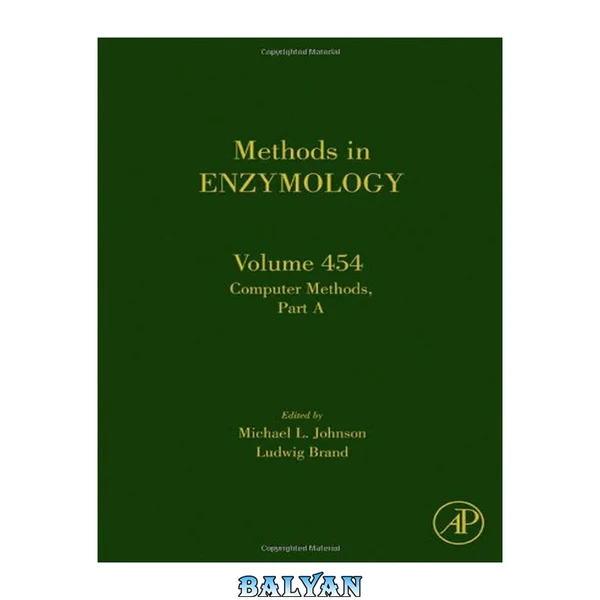
The combination of faster, more advanced computers and more quantitatively oriented biomedical researchers has recently yielded new and more precise methods for the analysis of biomedical data. These better analyses have enhanced the conclusions that can be drawn from biomedical data, and they have changed the way that experiments are designed and performed. This volume, along with previous and forthcoming Computer Methods volumes for the Methods in Enzymology serial, aims to inform biomedical researchers about recent applications of modern data analysis and simulation methods as applied to biomedical research. \* Presents step-by-step computer methods and discusses the techniques in detail to enable their implementation in solving a wide range of problems \* Informs biomedical researchers of the modern data analysis methods that have developed alongside computer hardware \*Presents methods at the "nuts and bolts" level to identify and resolve a problem and analyze what the results mean 1. Predicting fluorescence lifetimes and spectra of biopolymers -- Patrik R. Callis -- 2. Modeling of regulatory networks : theory and applications in the study of the Drosophila circadian clock -- Elizabeth Y. Scribner and Hassan M. Fathallah-Shaykh -- 3. Strategies for articulated multibody-based adaptive coarse grain simulation of RNA -- Mohammad Poursina, Kishor D. Bhalerao, Samuel C. Flores, Kurt S. Anderson, and Alain Laederach -- 4. Modeling loop entropy -- Gregory S. Chirikjian -- 5. Inferring functional relationships and causal network structure from gene expression profiles -- Radhakrishnan Nagarajan and Meenakshi Upreti -- 6. Numerical solution of the chemical master equation : uniqueness and stability of the stationary distribution for chemical networks, and mRNA bursting in a gene network with negative feedback regulation -- E.S. Zeron and M. Santillán -- 7. How molecular should your molecular model be? ^ -- Didier Gonze, Wassim Abou-Jaoudé, Djomangan Adama Ouattara, and José Halloy -- 8. Computational modeling of biological pathways by executable biology -- Maria Luisa Guerriero and John K. Heath -- 9. Computing molecular fluctuations in biochemical reaction systems based on a mechanistic, statistical theory of irreversible processes -- Don Kulasiri -- 10. Probing the input-output behavior of biochemical and genetic systems : system idenitification methods from control theory -- Jordan Ang, Brian Ingalls, and David McMillen -- 11. Biochemical pathway modeling tools for drug target detection in cancer and other complex diseases -- Alberto Marin-Sanguino, Shailendra K. Gupta, Eberhard O. Voit, and Julio Vera -- 12. Deterministic and stochastic simulation and analysis of biochemical reaction networks : the lactose operon example -- Necmettin Yildirim and Caner Kazanci-- 13. ^ Multivariate neighborhood sample entropy : a method for data reduction and prediction of complex data -- Joshua S. Richman -- 14. Scaling differences of heartbeat excursions between wake and sleep periods -- L. Guzmán-Vargas, I. Reyes Ramírez, R. Hernández-Pérez, and F. Angulo-Brown -- 15. Changepoint analysis for single-molecule polarized total internal reflection fuorescence microscopy experiments -- John F. Beausang, Yale E. Goldman, and Philip C. Nelson -- 16. Inferring mechanisms from dose-response curves -- Carson C. Chow, Karen M. Ong, Edward J. Dougherty, and S. Stoney Simons Jr. -- 17. Spatial aspects in biological system simulations -- Haluk Resat, Michelle N. Costa, and Harish Shankaran -- 18. Computational approaches to modeling viral structure and assembly -- Stephen C. Harvey, Anton S. Petrov, Batsal Devkota, and Mustafa Burak Boz -- 19. Rosetta3 : an object-oriented software suite for the simulation and design of macromolecules ^ -- Andrew Leaver-Fay, Michael Tyka, Steven M. Lewis [et al.] -- 20. Computational design of intermolecular stability and specificity in protein self-assembly -- Vikas Nanda, Sohail Zahid, Fei Xu, and Daniel Levine -- 21. Differential analysis of 2D gel images -- Feng Li and Franc̜oise Seillier-Moiseiwitsch.
The combination of faster, more advanced computers and more quantitatively oriented biomedical researchers has recently yielded new and more precise methods for the analysis of biomedical data. These better analyses have enhanced the conclusions that can be drawn from biomedical data, and they have changed the way that experiments are designed and performed. This volume, along with the 2 previous Computer Methods volumes for the Methods in Enzymology serial, aims to inform biomedical researchers about recent applications of modern data analysis and simulation methods as applied to biomedical research.
* Presents step-by-step computer methods and discusses the techniques in detail to enable their implementation in solving a wide range of problems * Informs biomedical researchers of the modern data analysis methods that have developed alongside computer hardware *Presents methods at the "nuts and bolts" level to identify and resolve a problem and analyze what the results mean