
Real-Time Rendering, Third Edition
Tomas Akenine-Möller, Eric Haines, Naty Hoffmanقیمت نهایی
- تخفیف زماندار−۹٬۰۰۰ تومان
۹٬۰۰۰ تومان صرفهجویی نسبت به قیمت اصلی
نسخه اصلی و اورجینال
بلافاصله پس از خرید، فایل کتاب روی دستگاه شما آمادهٔ دانلود است.
مشخصات کتاب
- سال انتشار
- ۲۰۰۸
- فرمت
- DJVU
- زبان
- انگلیسی
- حجم فایل
- ۹٫۴ مگابایت
- شابک
- 9781315359861، 9781315362007، 9781315365459، 9781439865293، 9781466561762، 9781498785631، 9781568814247، 1315359863، 1315362007، 1315365456، 1439865299، 1466561769، 1498785638، 1568814240
دربارهٔ کتاب
after Three Years This Wonderful All-around Resource Of Computer Graphics, Indispensable For Every Serious Graphics Programmer, Is Available In A Completely Revised And Updated Edition. Nearly Doubled In Size, The New Edition Keeps Pace With The Astonishing Developments In Hardware And Software That Have Increased The Speed And Quality Of Rendering Images. The New Edition Includes Information On The Latest Technology That Is Being Released Concurrently With The Publication. The Book's Trademark—blending Solid Theory And Practical Advice—remains Intact, Making It Mandatory For Every Programmer Who Wants To Stay At The Cutting Edge. The Book Contains Chapters As Diverse As: - Transforms - Visual Appearance - Acceleration Algorithms - Advanced Shading Techniques (new Chapter) - Curved Surfaces (new Chapter) With Topics Including: - Pixel Shaders - Subdivision Surfaces - Intersection Algorithms - Pipeline Tuning
electronic Review Of Computer Books - Jack Woehrregular Readers Of Ercb May Recall My Comments When Reviewing graphics Programming With Jfc:
It's An Editorial Blemish Not To Have Provided A Minimal Bibliography To Steer Novice Readers From The Paths Of Pop Techdom Towards The High Road Of Computer Science...
real-time Rendering, By Tomas Moeller And Eric Haines, Remedies That Omission. If You're Ready For The Mathematics Of 3d Computer Graphics, You're Ready For Real-time Rendering. The Authors State Their Objective Succinctly:
This Book Is About Algorithms Which Create Synthetic Images Fast Enough That The Viewer Can Interact With A Virtual Environment.
real-time Rendering Is A Real Textbook. The Text Is Medium-to-high Scientific English. To Read The Book, You Must Possess Some Familiarity With Matrix Math, Geometry, And Trigonometry. Equations Abound, As Do Citations.
The Presentation Is Both Professional And Scholarly. Moeller And Haines Weigh In With A Great Deal Of Practical Experience And An Equal Proportion Of Theoretical Familiarity. The Treatment Is Never Abstract. Specific Graphics Subsystems Are Named And Differences Between Them Noted In The Discussion. Rendering, Not Mathematics, Is The Focus.
The Headings Of Real-time Rendering's Content-rich Chapters Are:
1. Introduction
2. The Graphics Rendering Pipeline
3. Transforms
4. Visual Appearance
5. Texturing
6. Special Effects
7. Speed-up Techniques
8. Pipeline Optimization
9. Polygonal Techniques
10. Intersection Test Methods
11. Collision Detection
12. Graphics Hardware
13. The Future
Appendix A. Some Linear Algebra
Appendix B. Trigonometry
real-time Rendering Is About Process, Not Production. Hardware Involved In The Graphics Pipeline Is Presented At The Conceptual Level In Chapter 12, Graphics Hardware And Most Engagingly In 12.2.2 Case Study: Neon. The Metal Itself Is Not Mined. If It's Blit Rates And Bus Signals You Crave, You Want A Book Like agp System Architecture.
Overall, The Editing, Design, Layout, And Printing Of This Hardbound Volume Are Excellent. Care And Attention Have Been Lavished On Equation Presentation. In Addition To Copious Meticulous Geometric Diagrams, There Are A Number Of Plates Relevant To The Discussion. One Group Of Plates Is Color; The Rest Are Gray Scale. Several Of The Gray Scales Are, In My Review Copy, Unfortunately Printed A Bit Too Dark For Comfort, But This Is A Minor Flaw Compensated For Chez Nous By A Nifty Fluorescent Ring Work Light With Central Magnifying Lens.
I Learned The Basics Of Rendering By Taking Off My Shoes And Socks And Counting Toes, While Working Through Early Os/2 Presentation Manager Development Kit Documentation. It Is Gratifying That This Sort Of Approach Is Not Necessary For The Modern Computer-science Student Who Has Access To Books Like Real-time Rendering And To Some Of The 392 Reference Works Cited Therein, Bless The Bibliography.
Thoroughly revised, this third edition focuses on modern techniques used to generate synthetic three-dimensional images in a fraction of a second. With the advent of programmable shaders, a wide variety of new algorithms have arisen and evolved over the past few years. This edition discusses current, practical rendering methods used in games and other applications. It also presents a solid theoretical framework and relevant mathematics for the field of interactive computer graphics, all in an approachable style. The authors have made the figures used in the book available for download for fair use.:Download Figures. Reviews Rendering has been a required reference for professional graphics practitioners for nearly a decade. This latest edition is as relevant as ever, covering topics from essential mathematical foundations to advanced techniques used by today's cutting edge games. -- Gabe Newell, President, Valve, May 2008 Rendering... has been completely revised and revamped for its updated third edition, which focuses on modern techniques used to generate three-dimensional images in a fraction of the time old processes took. From practical rendering for games to math and details for better interactive applications, it's not to be missed. -- The Bookwatch, November 2008 You'll get brilliantly lucid explanations of concepts like vertex morphing and variance shadow mapping—as well as a new respect for the incredible craftsmanship that goes into today's PC games. -- Logan Decker, PC Gamer Magazine, February 2009 "Thoroughly revised, this third edition focuses on modern techniques used to generate synthetic three-dimensional images in a fraction of a second. - With the advent of programmable shaders, a wide variety of new algorithms have arisen and evolved over the past few years. This edition discusses current, practical rendering methods used in games and other applications. - It also presents a solid theoretical framework and relevant mathematics for the field of interactive computer graphics, all in an approachable style."--BOOK JACKETکتابهای مشابه

Real-Time Rendering, Third Edition
۴۹٬۰۰۰ تومان
Real-Time Rendering, Third Edition
۴۹٬۰۰۰ تومان
Real-Time Rendering, Third Edition
۴۹٬۰۰۰ تومان
Real-Time Rendering, Third Edition
۴۹٬۰۰۰ تومان
Real-Time Rendering, Second Edition
۴۹٬۰۰۰ تومان
Real-Time Rendering, Fourth Edition
۴۹٬۰۰۰ تومان
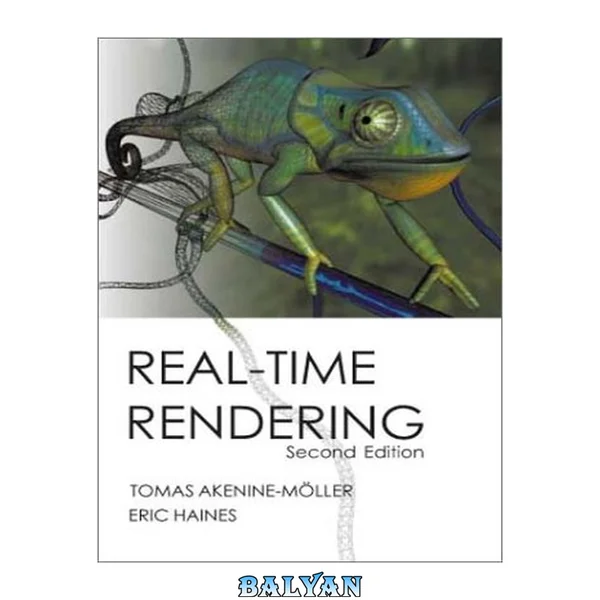
رندرینگ بلادرنگ، ویرایش دوم
۴۹٬۰۰۰ تومان
Real-Time Rendering, Fourth Edition
۴۹٬۰۰۰ تومان
Real-Time Rendering, Fourth Edition, 4th Edition
۴۹٬۰۰۰ تومان
Real-Time Rendering, Fourth Edition, 4th Edition
۴۹٬۰۰۰ تومان
Real-Time Rendering, Fourth Edition, 4th Edition
۴۹٬۰۰۰ تومان
Real Time Cloud Rendering for Games
۴۹٬۰۰۰ تومان
قیمت نهایی
۴۰٬۰۰۰ تومان